Buy zuandiao.com ?
We are moving the project
zuandiao.com .
Are you interested in purchasing the domain
zuandiao.com ?
domain@kv-gmbh.de · 0541-91531010
Buy zuandiao.com ?
Do you know technical ceramics?
Yes, I am familiar with technical ceramics. Technical ceramics are advanced ceramic materials that are engineered for specific applications that require high performance properties such as high temperature resistance, wear resistance, electrical insulation, and chemical inertness. They are used in a wide range of industries including aerospace, automotive, electronics, and medical devices due to their exceptional mechanical and thermal properties. Technical ceramics are often used in demanding environments where traditional materials like metals or plastics would not be suitable. **
Which is cheaper, a pottery course or owning a pottery wheel?
In general, taking a pottery course is likely to be cheaper than owning a pottery wheel. Pottery courses typically provide access to a variety of equipment, materials, and instruction for a set fee, whereas purchasing a pottery wheel can be a significant upfront investment. Additionally, pottery courses may offer the opportunity to try out different techniques and styles before committing to purchasing a wheel. Overall, taking a pottery course can be a more cost-effective way to explore pottery as a hobby or skill. **


Similar search terms for Moscato
Top-Angebote
Products related to Moscato:
-
Moscato Giallo Franz Haas 2024The Moscato Giallo by Franz Haas is a fine and aromatic wine, with a nose that surprises with its olfactory evolution. The mineral structure combines with a good freshness on the palate, contributing to a smooth drinking experience. A white that is splendidly suited for tasting during the aperitif, but is also perfect for the entire meal, pairing well with light recipes, even slightly spicy ones. A bottle born from the winery's desire to experiment, demonstrating the passion that has always fueled its creative intentions. The Moscato Giallo Franz Haas comes from vines cultivated using the Guyot system in plots located at an altitude between 400 and 450 meters above sea level. We are in Mazzon, where the vines grow facing south, southwest, and west, rooting in a mixed subsoil, predominantly composed of sand and clay. After a very brief maceration, useful for extracting the aromatic qualities from the Moscato grapes, soft pressing is carried out. The must ferments in stainless steel at controlled temperature, where it then remains.to refine for five months on the fine lees, thus further enhancing its aromatic profile. At the end of this period, it is bottled and can finally reach the tables of all enthusiasts. The Moscato Giallo Franz Haas presents itself visually with a color reminiscent of gold, very bright. The fruit engages the nose with various nuances, also crossing exotic references, and then in the finish shifting towards a fragrance of aromatic herbs and flowers. On the palate, it is light-bodied, characterized by a dry and aromatic taste, fresh in its offering with a savory taste profile; it closes with a slightly almond-like finish. A label born in 2010 almost by chance, which after just a few vintages has already managed to carve out a significant importance in the range signed by Franz Haas.25,00 £*Shipping: 48,00 £Secure redirect to the provider
-
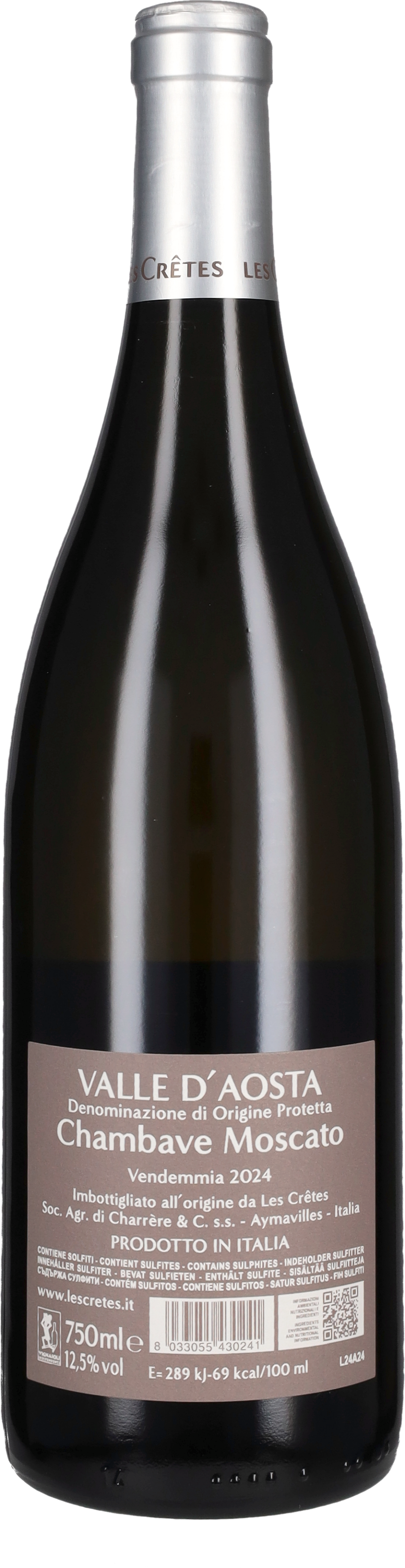
Chambave Moscato Les Cretes 2025The Chambave Moscato from the Aosta Valley estate Les Cretes is a dry white wine characterized by rich and sweet aromatic scents. The Chambave subzone, named after the small municipality located 20 kilometers east of the capital Aosta, is part of the Valle d'Aosta denomination and represents a prime area for Moscato Bianco, which here gives rise to some of the most interesting wines in the entire region. In fact, the locality has been renowned since the 15th century for its Moscato, traditionally vinified as passito as well as in a dry version. This was exported to nearby France, where it was also appreciated at the royal court. This is evidenced by a document stating that in 1494 Giorgio di Challant, a French cleric and patron, offered the Moscato Passito di Chambave to King Charles VIII of France. The Moscato Chambave Les Cretes is produced with only Moscato Bianco grapes grown at an altitude of about 500 meters above sea level on steep terraces. Following the harvest, the grapes are immediately transferred to the winery, where they are vinified through brief skin maceration and alcoholic fermentation in temperature-controlled stainless steel tanks. Still in stainless steel, the wine matures on the fine lees for 5 months, after which bottling takes place and further resting in glass precedes its market release. Visually, the Chambave Moscato from Les Cretes reveals a light and brilliant straw yellow hue. The aromatic bouquet is defined by fascinating varietal hints reminiscent of white peach, honeysuckle, lemon zest, sage, and thyme, enriched by a refined and subtle mineral vein. Tasting fresh and pleasantly savory, crisp and very fragrant, with a dry and juicy finish that invites further tastings.19,00 £*Shipping: 48,00 £Secure redirect to the provider
-
Moscato d'Asti La Caudrina 2025Il Moscato d’Asti della realtà produttiva La Caudrina è un’espressione fragrante e bilanciata, autentica manifestazione di questa celebre denominazione piemontese. Dopo decenni in cui Redento Dogliotti era impegnato nella vendita dei mosti da lui prodotti alla grande industria del Moscato d’Asti, sul finire degli anni ’70 arrivò la svolta per la tenuta di famiglia con il figlio Romano, il quale iniziò a vinificare in proprio dai vigneti più vocati e a imbottigliare con il suo nome, riscontrando subito un grande successo. Fu così che nacque il Moscato d’Asti La Caudrina, etichetta-simbolo della tenuta, la prima realizzata in assoluto dalla cantina. La Caudrina Moscato d’Asti nasce da sole uve Moscato Bianco, cresciute su terreni di matrice marnoso-calcarea a 280 metri sul livello del mare. I grappoli sono raccolti rigorosamente a mano e quindi subito pressati in maniera soffice, con il mosto così ottenuto che viene sottoposto a chiarificazioni e filtrazioni al fine di ottenere un liquido brillante. La massa è conservata in celle frigorifere fino al momento della fermentazione, che si svolge in autoclave a temperatura controllata con l’ausilio dei lieviti selezionati. La vinificazione e l’imbottigliamento sono eseguiti in condizioni isobariche, in modo tale da preservare la vivacità del vino. Alla vista, il Moscato d’Asti La Caudrina di Romano Dogliotti si presenta con una tonalità giallo paglierino carico. L’olfatto, di stampo aromatico, offre delicate sfumature floreali, alternate a note di agrumi canditi ed erbe aromatiche. In bocca risulta giustamente dolce, fresco e beverino, con una tenue effervescenza che anticipa la chiusura di buona persistenza. Come consuetudine per la tipologia, suggeriamo di gustare questo vino dolce in gioventù, magari nel periodo delle festività natalizie in accompagnamento ai classici pandoro e panettone.13,00 £*Shipping: 48,00 £Secure redirect to the provider
-
Moscato d Asti Massolino 2025ll Moscato d'Asti di Massolino è una raffinata ed elegante versione del vino dolce e vivace della grande tradizione piemontese. L’antico vitigno aromatico è coltivato da secoli nelle terre piemontesi, dove ha trovato terreni e clima per esprimere vini di particolare equilibrio. Il bouquet è caratterizzato da profumi di fiori bianchi, aromi d’agrumi, frutta bianca, sfumature vegetali di salvia e muschio. Il sorso è suadente e brioso, con frutto ricco, che si distende morbido al palato e trova la giusta armonia in un finale rinfrescante. E’ ottimo in abbinamento ai dolci tipici del territorio, come la torta di nocciole, di mele e pinoli oppure con della pasticceria secca o con i classici dolci natalizi. Il vino Moscato d'Asti è prodotto da Massolino con le pregiate uve che provengono dai vigneti di Serralunga d’Alba, nel cuore delle Langhe, dove la Cantina ha sede fin dal lontano 1896. Le vigne si trovano a un’altitudine di 320-340 metri sul livello del mare su terreni di matrice calcareo-argillosa. Le viti hanno un’età media attorno ai 20 anni e sono allevate a Guyot per una resa inferiore agli 80 quintali/ha. Dopo la vendemmia manuale, che per solito avviene nella seconda metà di settembre, i grappoli sono portati in cantina per la vinificazione. La fermentazione si svolge in tini d’acciaio a temperatura controllata e i vini base sono poi rifermentati in autoclave per mantenere intatto il profilo aromatico, fragrante e fruttato tipico del Moscato, senza modificare le sue note primarie più caratteristiche. ll Moscato d'Asti è il vino da dessert più famoso d’Italia, da sempre legato al concetto di festa e di convivialità. Il suo successo risiede nelle straordinarie qualità di un’uva aromatica e nel perfetto equilibrio gustativo tra dolcezza e freschezza. La Cantina Massolino produce il Moscato nella pregiata zona delle Langhe di Serralunga, terra storicamente legata alle grandi bottiglie di Barolo. Nel calice ha un colore giallo paglierino brillante, con una spuma sottile e delicata. Il bouquet ricorda profumi di zagara, biancospino, agrumi, pesca bianca, muschio, cenni vegetali di salvia e di erbe officinali. Al palato è morbido, con frutto dolce e maturo, ben contrastato da una vivace freschezza finale, che dona slancio alla beva.12,00 £*Shipping: 48,00 £Secure redirect to the provider



-
What is cheaper, a pottery course or owning a pottery wheel?
In general, taking a pottery course is usually cheaper than owning a pottery wheel. Pottery courses typically provide access to a pottery wheel, kiln, and other necessary tools and materials for a set fee. On the other hand, owning a pottery wheel requires a significant upfront investment in purchasing the equipment, as well as ongoing costs for maintenance, clay, glazes, and firing. Additionally, taking a pottery course allows for instruction, guidance, and a supportive community, which can be beneficial for beginners. **
-
What is cheaper, a pottery class or your own pottery wheel?
In general, a pottery class is usually cheaper than purchasing your own pottery wheel. Pottery classes typically provide all the necessary materials, tools, and instruction needed to create pottery pieces, whereas buying a pottery wheel can be a significant investment. Additionally, pottery classes offer the opportunity to learn from experienced instructors and interact with other students, which can enhance the overall learning experience. However, if you plan to make pottery regularly and have the space and resources to set up a pottery studio at home, investing in your own pottery wheel may be more cost-effective in the long run. **
-
Which is cheaper, a pottery course or buying your own pottery wheel?
In general, taking a pottery course is likely to be cheaper than buying your own pottery wheel. Pottery courses typically provide access to all the necessary equipment, materials, and instruction for a set fee, whereas purchasing a pottery wheel can be a significant investment. Additionally, pottery courses offer the opportunity to learn from experienced instructors and interact with other students, which can enhance the overall learning experience. However, if you plan to continue practicing pottery long-term, buying your own pottery wheel may eventually be more cost-effective. **
-
How does one learn pottery?
Learning pottery involves a combination of practice, patience, and guidance from experienced potters. Beginners can start by taking classes at a local pottery studio or community center to learn the basics of hand-building techniques, wheel-throwing, and glazing. It is important to practice regularly and experiment with different techniques to develop skills and find one's own style. Additionally, watching tutorials, reading books, and attending workshops can also help in expanding knowledge and improving pottery skills. **


Is it worth learning pottery?
Learning pottery can be a rewarding and fulfilling experience for many people. It allows for creativity and self-expression, as well as the opportunity to develop patience and focus. Additionally, pottery can be a therapeutic and stress-relieving activity. Whether you are looking to explore a new hobby or develop a new skill, learning pottery can be a valuable and enjoyable pursuit. **
Which textiles bleed?
Textiles made from natural fibers such as cotton, linen, and silk are more likely to bleed when washed. This is because natural fibers have a tendency to release dye when they come into contact with water and detergent. On the other hand, synthetic fibers like polyester and nylon are less likely to bleed because they are typically dyed using different methods that make the dye more resistant to washing. It's important to follow the care instructions on the garment's label to minimize bleeding and preserve the color of the fabric. **
Top-Angebote
Products related to Moscato:
-
Moscato Giallo Erste+Neue 2025the characteristics of the grape variety. The maceration period with the skins is 6 hours, the alcoholic fermentation takes place at controlled temperature in steel tanks, where the subsequent aging also occurs. All operations are carried out without the presence of oxygen, to preserve the integrity of the grapes. The Moscato Giallo Erste+Neue is characterized by a pale straw yellow. Once poured into the glass, the aromas that reach the nose are primarily fruity, with sweeter notes of yellow peach, and more acidic citrus notes. There are also pronounced hints of mountain herbs, which evoke the spectacular landscapes of Alto Adige, with mountains and greenery. The bouquet is punctuated by some spicy notes that add an extra touch. On the palate, it is a fresh and delicate white, easy to drink, with mineral notes and the aromatic ones of Moscato. It has freshness and liveliness, and pairs excellently with fish, fresh cheeses, and vegetables. the characteristics of the grape variety. The maceration period with the skins is 6 hours, the alcoholic fermentation takes place at controlled temperature in steel tanks, where the subsequent aging also occurs. All operations are carried out without the presence of oxygen, to preserve the integrity of the grapes. The Moscato Giallo Erste+Neue is characterized by a pale straw yellow. Once poured into the glass, the aromas that reach the nose are primarily fruity, with sweeter notes of yellow peach, and more acidic citrus notes. There are also pronounced hints of mountain herbs, which evoke the spectacular landscapes of Alto Adige, with mountains and greenery. The bouquet is punctuated by some spicy notes that add an extra touch. On the palate, it is a fresh and delicate white, easy to drink, with mineral notes and the aromatic ones of Moscato. It has freshness and liveliness, and pairs excellently with fish, fresh cheeses, and vegetables.11,00 £*Shipping: 48,00 £Secure redirect to the provider
-
Moscato Giallo Franz Haas 2024The Moscato Giallo by Franz Haas is a fine and aromatic wine, with a nose that surprises with its olfactory evolution. The mineral structure combines with a good freshness on the palate, contributing to a smooth drinking experience. A white that is splendidly suited for tasting during the aperitif, but is also perfect for the entire meal, pairing well with light recipes, even slightly spicy ones. A bottle born from the winery's desire to experiment, demonstrating the passion that has always fueled its creative intentions. The Moscato Giallo Franz Haas comes from vines cultivated using the Guyot system in plots located at an altitude between 400 and 450 meters above sea level. We are in Mazzon, where the vines grow facing south, southwest, and west, rooting in a mixed subsoil, predominantly composed of sand and clay. After a very brief maceration, useful for extracting the aromatic qualities from the Moscato grapes, soft pressing is carried out. The must ferments in stainless steel at controlled temperature, where it then remains.to refine for five months on the fine lees, thus further enhancing its aromatic profile. At the end of this period, it is bottled and can finally reach the tables of all enthusiasts. The Moscato Giallo Franz Haas presents itself visually with a color reminiscent of gold, very bright. The fruit engages the nose with various nuances, also crossing exotic references, and then in the finish shifting towards a fragrance of aromatic herbs and flowers. On the palate, it is light-bodied, characterized by a dry and aromatic taste, fresh in its offering with a savory taste profile; it closes with a slightly almond-like finish. A label born in 2010 almost by chance, which after just a few vintages has already managed to carve out a significant importance in the range signed by Franz Haas.25,00 £*Shipping: 48,00 £Secure redirect to the provider
-
Chambave Moscato Les Cretes 2025The Chambave Moscato from the Aosta Valley estate Les Cretes is a dry white wine characterized by rich and sweet aromatic scents. The Chambave subzone, named after the small municipality located 20 kilometers east of the capital Aosta, is part of the Valle d'Aosta denomination and represents a prime area for Moscato Bianco, which here gives rise to some of the most interesting wines in the entire region. In fact, the locality has been renowned since the 15th century for its Moscato, traditionally vinified as passito as well as in a dry version. This was exported to nearby France, where it was also appreciated at the royal court. This is evidenced by a document stating that in 1494 Giorgio di Challant, a French cleric and patron, offered the Moscato Passito di Chambave to King Charles VIII of France. The Moscato Chambave Les Cretes is produced with only Moscato Bianco grapes grown at an altitude of about 500 meters above sea level on steep terraces. Following the harvest, the grapes are immediately transferred to the winery, where they are vinified through brief skin maceration and alcoholic fermentation in temperature-controlled stainless steel tanks. Still in stainless steel, the wine matures on the fine lees for 5 months, after which bottling takes place and further resting in glass precedes its market release. Visually, the Chambave Moscato from Les Cretes reveals a light and brilliant straw yellow hue. The aromatic bouquet is defined by fascinating varietal hints reminiscent of white peach, honeysuckle, lemon zest, sage, and thyme, enriched by a refined and subtle mineral vein. Tasting fresh and pleasantly savory, crisp and very fragrant, with a dry and juicy finish that invites further tastings.19,00 £*Shipping: 48,00 £Secure redirect to the provider
-
Do you know technical ceramics?
Yes, I am familiar with technical ceramics. Technical ceramics are advanced ceramic materials that are engineered for specific applications that require high performance properties such as high temperature resistance, wear resistance, electrical insulation, and chemical inertness. They are used in a wide range of industries including aerospace, automotive, electronics, and medical devices due to their exceptional mechanical and thermal properties. Technical ceramics are often used in demanding environments where traditional materials like metals or plastics would not be suitable. **
-
Which is cheaper, a pottery course or owning a pottery wheel?
In general, taking a pottery course is likely to be cheaper than owning a pottery wheel. Pottery courses typically provide access to a variety of equipment, materials, and instruction for a set fee, whereas purchasing a pottery wheel can be a significant upfront investment. Additionally, pottery courses may offer the opportunity to try out different techniques and styles before committing to purchasing a wheel. Overall, taking a pottery course can be a more cost-effective way to explore pottery as a hobby or skill. **
-
What is cheaper, a pottery course or owning a pottery wheel?
In general, taking a pottery course is usually cheaper than owning a pottery wheel. Pottery courses typically provide access to a pottery wheel, kiln, and other necessary tools and materials for a set fee. On the other hand, owning a pottery wheel requires a significant upfront investment in purchasing the equipment, as well as ongoing costs for maintenance, clay, glazes, and firing. Additionally, taking a pottery course allows for instruction, guidance, and a supportive community, which can be beneficial for beginners. **
-
What is cheaper, a pottery class or your own pottery wheel?
In general, a pottery class is usually cheaper than purchasing your own pottery wheel. Pottery classes typically provide all the necessary materials, tools, and instruction needed to create pottery pieces, whereas buying a pottery wheel can be a significant investment. Additionally, pottery classes offer the opportunity to learn from experienced instructors and interact with other students, which can enhance the overall learning experience. However, if you plan to make pottery regularly and have the space and resources to set up a pottery studio at home, investing in your own pottery wheel may be more cost-effective in the long run. **
Similar search terms for Moscato
-
Moscato d'Asti La Caudrina 2025Il Moscato d’Asti della realtà produttiva La Caudrina è un’espressione fragrante e bilanciata, autentica manifestazione di questa celebre denominazione piemontese. Dopo decenni in cui Redento Dogliotti era impegnato nella vendita dei mosti da lui prodotti alla grande industria del Moscato d’Asti, sul finire degli anni ’70 arrivò la svolta per la tenuta di famiglia con il figlio Romano, il quale iniziò a vinificare in proprio dai vigneti più vocati e a imbottigliare con il suo nome, riscontrando subito un grande successo. Fu così che nacque il Moscato d’Asti La Caudrina, etichetta-simbolo della tenuta, la prima realizzata in assoluto dalla cantina. La Caudrina Moscato d’Asti nasce da sole uve Moscato Bianco, cresciute su terreni di matrice marnoso-calcarea a 280 metri sul livello del mare. I grappoli sono raccolti rigorosamente a mano e quindi subito pressati in maniera soffice, con il mosto così ottenuto che viene sottoposto a chiarificazioni e filtrazioni al fine di ottenere un liquido brillante. La massa è conservata in celle frigorifere fino al momento della fermentazione, che si svolge in autoclave a temperatura controllata con l’ausilio dei lieviti selezionati. La vinificazione e l’imbottigliamento sono eseguiti in condizioni isobariche, in modo tale da preservare la vivacità del vino. Alla vista, il Moscato d’Asti La Caudrina di Romano Dogliotti si presenta con una tonalità giallo paglierino carico. L’olfatto, di stampo aromatico, offre delicate sfumature floreali, alternate a note di agrumi canditi ed erbe aromatiche. In bocca risulta giustamente dolce, fresco e beverino, con una tenue effervescenza che anticipa la chiusura di buona persistenza. Come consuetudine per la tipologia, suggeriamo di gustare questo vino dolce in gioventù, magari nel periodo delle festività natalizie in accompagnamento ai classici pandoro e panettone.13,00 £*Shipping: 48,00 £Secure redirect to the provider
-
Moscato d Asti Massolino 2025ll Moscato d'Asti di Massolino è una raffinata ed elegante versione del vino dolce e vivace della grande tradizione piemontese. L’antico vitigno aromatico è coltivato da secoli nelle terre piemontesi, dove ha trovato terreni e clima per esprimere vini di particolare equilibrio. Il bouquet è caratterizzato da profumi di fiori bianchi, aromi d’agrumi, frutta bianca, sfumature vegetali di salvia e muschio. Il sorso è suadente e brioso, con frutto ricco, che si distende morbido al palato e trova la giusta armonia in un finale rinfrescante. E’ ottimo in abbinamento ai dolci tipici del territorio, come la torta di nocciole, di mele e pinoli oppure con della pasticceria secca o con i classici dolci natalizi. Il vino Moscato d'Asti è prodotto da Massolino con le pregiate uve che provengono dai vigneti di Serralunga d’Alba, nel cuore delle Langhe, dove la Cantina ha sede fin dal lontano 1896. Le vigne si trovano a un’altitudine di 320-340 metri sul livello del mare su terreni di matrice calcareo-argillosa. Le viti hanno un’età media attorno ai 20 anni e sono allevate a Guyot per una resa inferiore agli 80 quintali/ha. Dopo la vendemmia manuale, che per solito avviene nella seconda metà di settembre, i grappoli sono portati in cantina per la vinificazione. La fermentazione si svolge in tini d’acciaio a temperatura controllata e i vini base sono poi rifermentati in autoclave per mantenere intatto il profilo aromatico, fragrante e fruttato tipico del Moscato, senza modificare le sue note primarie più caratteristiche. ll Moscato d'Asti è il vino da dessert più famoso d’Italia, da sempre legato al concetto di festa e di convivialità. Il suo successo risiede nelle straordinarie qualità di un’uva aromatica e nel perfetto equilibrio gustativo tra dolcezza e freschezza. La Cantina Massolino produce il Moscato nella pregiata zona delle Langhe di Serralunga, terra storicamente legata alle grandi bottiglie di Barolo. Nel calice ha un colore giallo paglierino brillante, con una spuma sottile e delicata. Il bouquet ricorda profumi di zagara, biancospino, agrumi, pesca bianca, muschio, cenni vegetali di salvia e di erbe officinali. Al palato è morbido, con frutto dolce e maturo, ben contrastato da una vivace freschezza finale, che dona slancio alla beva.12,00 £*Shipping: 48,00 £Secure redirect to the provider
-
Moscato d'Asti La Caudrina 2026The Moscato d’Asti from the La Caudrina winery is a fragrant and balanced expression, an authentic manifestation of this famous Piedmontese denomination. After decades in which Redento Dogliotti was engaged in selling the musts he produced to the large Moscato d’Asti industry, at the end of the 1970s, a turning point arrived for the family estate with his son Romano, who began to vinify on his own from the most suitable vineyards and to bottle under his name, immediately achieving great success. Thus, the Moscato d’Asti La Caudrina was born, a symbolic label of the estate, the first ever produced by the winery. La Caudrina Moscato d’Asti is made from only Moscato Bianco grapes, grown in marl-limestone soils at 280 meters above sea level. The bunches are strictly hand-picked and then immediately softly pressed, with the must obtained being subjected to clarifications and filtrations in order to obtain a brilliant liquid. The mass is kept in refrigerated cells until the moment of fermentation, which takes place in autoclave at controlled temperature with the aid of selected yeasts. The vinification and bottling are carried out under isobaric conditions, in order to preserve the wine's vivacity. To the eye, the Moscato d’Asti La Caudrina by Romano Dogliotti presents itself with a deep straw yellow hue. The nose, of an aromatic nature, offers delicate floral nuances, alternating with notes of candied citrus and aromatic herbs. On the palate, it is rightly sweet, fresh, and drinkable, with a light effervescence that leads to a finish of good persistence. As is customary for this type, we suggest enjoying this sweet wine while young, perhaps during the Christmas holidays alongside classic pandoro and panettone.13,00 £*Shipping: 48,00 £Secure redirect to the provider
-
Which is cheaper, a pottery course or buying your own pottery wheel?
In general, taking a pottery course is likely to be cheaper than buying your own pottery wheel. Pottery courses typically provide access to all the necessary equipment, materials, and instruction for a set fee, whereas purchasing a pottery wheel can be a significant investment. Additionally, pottery courses offer the opportunity to learn from experienced instructors and interact with other students, which can enhance the overall learning experience. However, if you plan to continue practicing pottery long-term, buying your own pottery wheel may eventually be more cost-effective. **
-
How does one learn pottery?
Learning pottery involves a combination of practice, patience, and guidance from experienced potters. Beginners can start by taking classes at a local pottery studio or community center to learn the basics of hand-building techniques, wheel-throwing, and glazing. It is important to practice regularly and experiment with different techniques to develop skills and find one's own style. Additionally, watching tutorials, reading books, and attending workshops can also help in expanding knowledge and improving pottery skills. **
-
Is it worth learning pottery?
Learning pottery can be a rewarding and fulfilling experience for many people. It allows for creativity and self-expression, as well as the opportunity to develop patience and focus. Additionally, pottery can be a therapeutic and stress-relieving activity. Whether you are looking to explore a new hobby or develop a new skill, learning pottery can be a valuable and enjoyable pursuit. **
-
Which textiles bleed?
Textiles made from natural fibers such as cotton, linen, and silk are more likely to bleed when washed. This is because natural fibers have a tendency to release dye when they come into contact with water and detergent. On the other hand, synthetic fibers like polyester and nylon are less likely to bleed because they are typically dyed using different methods that make the dye more resistant to washing. It's important to follow the care instructions on the garment's label to minimize bleeding and preserve the color of the fabric. **
* All prices are inclusive of VAT and, if applicable, plus shipping costs. The offer information is based on the details provided by the respective shop and is updated through automated processes. Real-time updates do not occur, so deviations can occur in individual cases. ** Note: Parts of this content were created by AI.